Human in the Loop in Customer Service: Where the Handoff Point Belongs
Where should AI hand a customer service conversation to a person? Three escalation triggers, four handoff patterns and the metrics that expose late transfers.
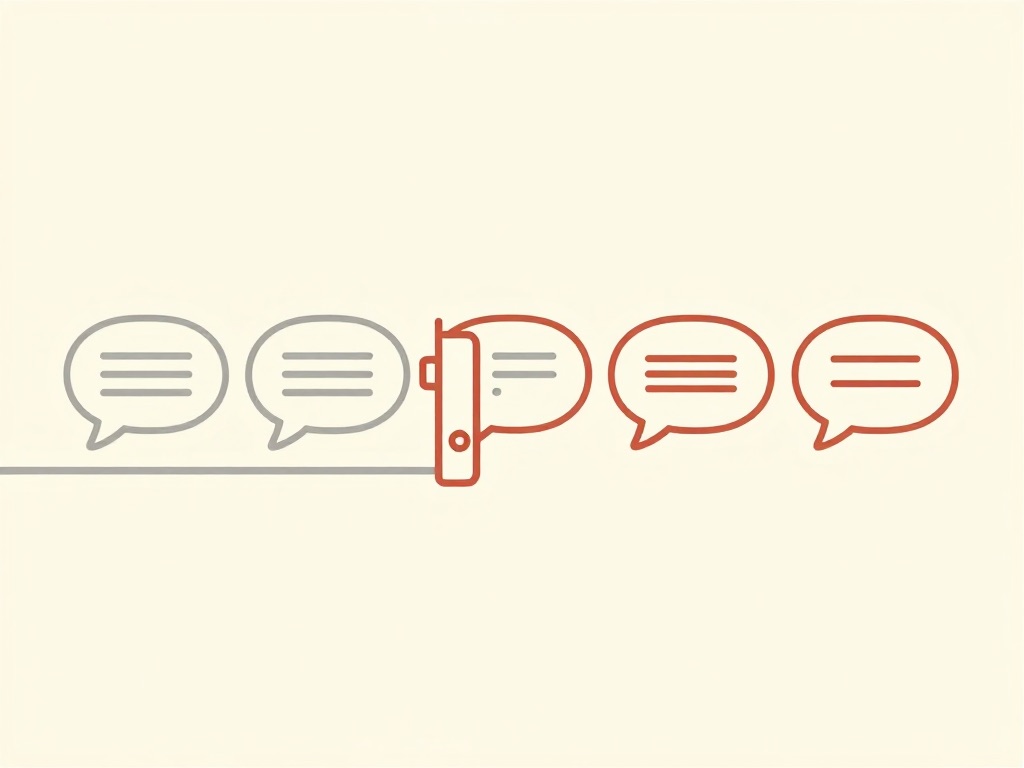
A refund dispute, a bereavement notification and a “where’s my order?” all land in the same queue. Only one of them should ever be closed by a model with no person involved, and your containment dashboard cannot tell you which one: it ranks conversations by volume, never by what they cost when they go wrong.
Most teams write their escalation rule as a safety net — the bot tries, the bot fails, a human picks up the pieces. That sequence is the single most expensive design decision in AI-assisted customer service, because it puts the person on the wrong side of the action.
The short answer: three triggers, and one of them fires first
Put the handoff point immediately before the first irreversible or regulated action, not after the AI has failed. In practice that means three triggers running in parallel: a risk trigger (the next step moves money, changes an entitlement or feeds a regulated decision), a confidence trigger (retrieval or intent score below a floor you derived from your own logs, or an answer with no grounded source) and a customer trigger (an explicit request for a person, a second rephrasing of the same question, or a distress or vulnerability marker). The risk trigger is designed in advance and fires before the AI answers; the other two fire mid-conversation. If “the bot could not help” is your only trigger, your handoff point is late by definition.
The rest of this piece is about drawing that line across your own contact types, and about how to tell whether you have drawn it in the right place.
Why “escalate on failure” is the wrong default
Failure-based escalation optimises for containment, and containment rewards the bot for holding on to a conversation it should never have started. The metric cannot tell the difference between a question answered well and a customer who gave up.
It also ignores cost asymmetry. A wrong answer about resetting a password costs one retry. A wrong answer about cancelling a policy, closing an account or accepting a hardship claim costs a complaint file, a remediation exercise and sometimes a regulator’s attention. The handoff point should follow the asymmetry, not the difficulty.
There is a third reason, and it is human rather than technical. Once a person inherits a conversation the AI has already half-committed to, they tend to defend the AI’s framing instead of reopening it — the well-documented pull of automation bias. A reviewer who arrives after the promise has been made is not really in the loop; they are downstream of it.
Map the journey by reversibility, not by topic
Most teams segment by topic — billing, delivery, technical. Topic is the wrong axis, because “billing” holds both “send me last month’s invoice” and “waive this fee”. Segment by what happens when the answer is wrong.
The reversibility test
Ask three questions about the next action in the conversation.
- Can the customer put it right themselves in under a minute? Moving a delivery slot: yes. Cancelling a contract inside a cooling-off window: only if they spot the mistake before the window shuts, which is not the same thing.
- Does it leave a record an auditor, ombudsman or regulator could read? Complaints, claim decisions, credit and insurance outcomes and anything logged as a formal request all do.
- Is a deadline attached? Dispute windows, statutory complaint clocks and cooling-off periods turn a slow answer into a wrong answer.
A “no” to the first question, or a “yes” to either of the others, puts a person before the action rather than after it.
The stakes grid
Plot every intent on two axes: reversibility (easy to undo → irreversible) and stakes (trivial → financial, legal or emotional). The handoff point is the boundary you draw across that grid, and it is a business decision rather than a model decision. Write it down, date it and treat moving it as a change that needs evidence.
Four places the handoff can sit
Most operations need more than one of these running at once. They fail in different ways, so each needs its own metric.
| Pattern | What triggers it | Best for | Typical failure | Metric that catches the failure |
|---|---|---|---|---|
| Pre-emptive gate | Intent classified as high-risk before the AI replies | Money movement, cancellations, complaints, vulnerability disclosures | Over-gating — routing so much that the automation has no business case | Share of gated contacts the agent resolved without using any permission the AI lacked |
| Confidence threshold | Score below a set floor, or no grounded source retrieved | Long-tail knowledge questions | Confidently wrong answers never trip the threshold | Wrong-answer rate found in blind-sampled transcripts, not escalation volume |
| Customer-pulled | “Agent”, repeated rephrasing, sentiment or distress signal | Everything — it is the floor, not a tier | Buried behind menus, or the bot argues before it concedes | Turns between the first request for a person and the transfer |
| Human-on-the-loop review | Nothing live; sampled or approval-queued after the fact | High-volume, low-risk email and macro drafting | Review degrades into rubber-stamping | Edit and override rate — if it trends towards zero, the review is theatre |
The fourth row is worth dwelling on. After-the-fact review is genuinely useful for drafting and genuinely useless as a control on anything irreversible, because by the time the reviewer opens the transcript the customer already has the answer.
Part of this line is drawn for you
Regulation rarely tells you where to put the handoff, but it does tell you which side of the line certain conversations sit on. Check the current wording and dates at the primary source before you design against any of these — several are still moving.
- EU AI Act, Article 50. Systems that interact directly with people must be built so that the person is told they are dealing with an AI, unless that is obvious. These transparency obligations have applied since 2 August 2026. Disclosure is not a handoff, but it changes how you script the opening turn.
- EU AI Act, Annex III. If the conversation feeds creditworthiness assessment, life or health insurance pricing, or access to essential public services, the system can fall into the high-risk category and inherit the human oversight duties of Article 14.
- GDPR, Article 22. Where a decision is based solely on automated processing and produces legal or similarly significant effects, the person has the right to obtain human intervention, express their point of view and contest the outcome. An AI that declines a claim with no human route is not a design preference; it is a compliance gap.
- California Business and Professions Code §17941 (SB 1001). It is unlawful to use a bot to mislead someone about its artificial identity in order to incentivise a sale or influence a vote.
- FCC declaratory ruling of 8 February 2024. AI-generated voices in robocalls count as “artificial” under the TCPA, which brings outbound voice AI under the same prior-consent rules.
- UK FCA Consumer Duty. The consumer support outcome requires firms not to put unreasonable barriers in the way of customers, including barriers to complaining. A bot that will not hand over is exactly that kind of barrier, and the FCA’s guidance on vulnerable customers (FG21/1) raises the bar further.
Rules with unsettled commencement dates — Colorado’s AI Act (SB 24-205), rescheduled more than once, is the obvious example — belong on a watch list and should be checked on the legislature’s own site rather than in a vendor deck.
The handoff itself is a design, not a button
A correctly placed handoff point still fails if the transfer is bad. Four rules cover most of it.
Pass context, not a ticket number. The person should arrive with a summary, the verified identity state and, above all, a list of anything the AI has already promised. Nothing burns trust faster than an agent quietly walking back a commitment the customer believes they have.
Never make the customer repeat themselves or prove who they are twice. If your platform cannot carry authentication state across the transfer, that limitation belongs in the design review, not in the customer’s lap.
Be honest about the wait. A real queue position beats a simulated typing indicator. If the wait is long, say so and offer a callback rather than holding someone in a conversation that is going nowhere.
Make the AI stop talking. Half-handoffs, where the assistant carries on replying while an agent is typing, are common and read as chaos. The transfer should be a clean switch, marked visibly in the transcript.
Measure escalation quality, not escalation volume
Containment on its own tells you almost nothing. Five numbers tell you whether the handoff point sits in the right place, and every one can be built from logs you already have.
- Late-escalation rate — the share of transferred conversations where the customer had already asked for a person, or where the transfer came after a set number of turns. This is the most direct measure of a handoff point placed too late.
- Escalation precision — of the conversations the AI escalated, how many genuinely needed a person? High volume with low precision usually means you gated on topic rather than on risk.
- Seven-day re-contact rate on AI-resolved conversations — the honest version of containment. A conversation that comes back was never contained.
- Onward-transfer rate — how often the agent who receives the conversation has to pass it on again, which normally means the gate picked the wrong queue rather than the wrong side of the line.
- Complaint and remediation rate on AI-touched contacts against human-only contacts — the number your risk and compliance colleagues will eventually ask for, so build it before they do.
Precision and wrong-answer rate need blind sampling: pull a fixed sample of AI-resolved conversations each week, have two reviewers rate them without knowing which ones the model flagged, and track where the two disagree. If your reviewers agree with the model on everything, check whether they are reading the transcript or the model’s own summary of it.
Placing your first handoff point this quarter
- Export four weeks of transcripts and cluster them by intent. The clustering does not have to be clever; it has to be exhaustive.
- Tag each intent with reversibility and stakes, using the three questions above.
- Draw the boundary and route everything above it to a pre-emptive gate, before the AI composes an answer.
- Set the confidence floor from the actual score distribution in your logs, not from the vendor default. If your platform does not expose that score in the transcript log, that is a procurement question to raise now.
- Instrument the five metrics, sample weekly and move the line deliberately, with a dated change log, so that six months from now someone can reconstruct why it sits where it does.
Three mistakes worth naming
Treating the handoff as tier two. Escalation to an agent is a change in who is accountable, not a jump in seniority. Some handoffs go to your least experienced people, and that is fine as long as accountability moved with the conversation.
Gating on emotion alone. Sentiment detection is a useful trigger and a poor sole trigger. Calm customers ask for irreversible things all day.
Letting the vendor set the threshold. A default confidence floor is tuned for a demo, on someone else’s traffic, with someone else’s cost of being wrong.
The handoff point is not where the AI gives up. It is where you decided, in advance, that a person owns the outcome. Keeping that decision explicit, measured and open to revision is most of what human in the loop means in customer service.
Frequently asked
What is a healthy escalation rate for an AI customer service assistant?
There is no cross-industry benchmark worth copying, because the number is driven almost entirely by your intent mix — a utility with meter disputes and a retailer with delivery queries cannot share a target. Build your own baseline from four weeks of transcripts, then track escalation precision and late-escalation rate rather than the headline rate. If someone quotes you an industry figure, ask which intents it covers before you plan against it.
Does the AI have to tell customers it is not a human?
In the EU, Article 50 of the AI Act requires systems interacting directly with people to be designed so the person is informed they are dealing with an AI, with those transparency obligations in force since 2 August 2026. California's SB 1001 already prohibits misleading people about a bot's artificial identity when it is used to incentivise a transaction. Beyond compliance, upfront disclosure reduces the frustration spiral that produces late escalations.
Does human review after the conversation satisfy GDPR Article 22?
Not by itself. Article 22 gives the person a right to obtain human intervention, express their point of view and contest a decision that was based solely on automated processing and has legal or similarly significant effects — that is a route the customer can invoke, not a sampling exercise your quality team runs later. Confirm the specific design with your data protection officer, because whether a decision counts as "solely automated" depends on how meaningful the human involvement actually is.
Should the handoff point differ between chat and voice?
The triggers are the same, but voice punishes bad execution harder because there is no scrollback and the customer cannot see what was already agreed. Pass a spoken-language summary and the verified identity state to the agent before the line connects, and never transfer into silence. Outbound voice adds its own constraint in the US, where the FCC's February 2024 ruling treats AI-generated voices in robocalls as artificial under the TCPA.
What if a customer asks for a person on something the AI could have handled?
Hand over. The customer-pulled trigger is a floor, not a negotiation, and a bot that argues before conceding creates exactly the kind of barrier the UK's Consumer Duty consumer support outcome targets. Log every denied or delayed request separately — a rising count is usually the first visible symptom of a handoff point drifting too far right.
How do we stop human review from becoming a rubber stamp?
Watch the edit and override rate on reviewed items; if it trends towards zero, the review has stopped being a control. Give reviewers the raw transcript rather than the model's own summary, rotate who reviews what, and give them a genuine path to reject that does not cost them their handle-time targets. Reserve after-the-fact review for drafting and low-risk work, and use a pre-emptive gate for anything irreversible.